The Samyang AF 85mm f/1.4 promises portrait performance at a fraction of the cost of premium alternatives, but can a $500 lens really compete with Canon's $3,000 RF 85mm f/1.2? The helpful video puts both lenses through rigorous testing to determine if the massive price difference translates to meaningful performance gaps.
Coming to you from Shane Long Photography, this comprehensive video comparison examines the Samyang AF 85mm f/1.4 against Canon's flagship portrait lens across multiple key areas. Long starts by addressing his primary concern: the Canon RF 85mm f/1.2 spends too much time sitting unused in his camera bag, making its nearly $3,000 price tag difficult to justify for his shooting style. The size and weight factor also plays a crucial role, as hand-holding the heavy Canon lens during long wedding days has become problematic for his wrist. Through careful side-by-side comparisons using identical camera settings and tripod positioning, Long evaluates whether the Samyang can deliver similar results for a fraction of the investment. His testing methodology includes examining bokeh quality at multiple apertures, sharpness across the frame, and real-world autofocus performance.
Key Specs
- Focal Length: 85mm
- Maximum Aperture: f/1.4
- Minimum Aperture: f/16
- Lens Mount: Canon RF, Sony E, Nikon F
- Format Coverage: Full frame
- Angle of View: 28.4°
- Minimum Focus Distance: 2.95 ft / 90 cm
- Magnification: 0.11x
- Optical Design: 9 elements in 7 groups
- Aperture Blades: 9, rounded
- Filter Size: 77mm
- Dimensions: 3.46 x 2.93 inches
- Weight: 1.06 lb / 480 g
The bokeh comparison reveals interesting results that challenge assumptions about expensive glass. Long discovers that while the Canon does produce slightly larger, more pronounced background blur due to its wider maximum aperture and longer effective focal length, the difference becomes negligible in practical shooting scenarios. At f/2, both lenses deliver virtually identical background separation that clients would never distinguish between. However, the sharpness testing exposes more significant differences, particularly in how each lens performs across the frame. The Canon maintains razor-sharp detail from center to edge even wide open, while the Samyang shows noticeable softness toward the frame edges at maximum aperture. Long's pixel-peeping at 300% magnification demonstrates clear advantages for the Canon when shooting at f/1.2 versus f/1.4, though he questions whether such extreme enlargements matter for typical print sizes.
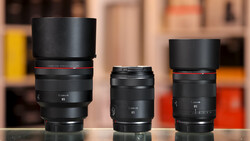
The autofocus performance and physical characteristics present compelling arguments for both lenses. Long's burst shooting tests with his son running directly toward the camera reveal impressive tracking capabilities from the Samyang, nailing focus on 27 out of 32 shots before losing track near the end of the sequence. The weight difference proves substantial: the Samyang weighs just 1.28 pounds compared to the Canon's 2.63 pounds, representing more than a 50% reduction that becomes meaningful during extended handheld shooting sessions. Check out the video above for the full rundown from Long.



1 Comment
The AF version of the Samyang lens isn’t available anymore in the Netherlands. And I’ve read of people complaining that the AF doesn’t work anymore after updating the camera software. So the choices here are buying the manual focus RF version or the autofocus EF version. If I was a pro photographer I would buy the Canon, as an amateur the Samyang sounds very tempting. A second hand Zeiss Milvus 1.4/85 sounds even more tempting